Saturday, April 23, 2011

Euro-carpin'

I recently acquired a delightful little book entitled Fish of the Summer Still Waters. Written by several British anglers in 1991, the book discusses some of the more obscure game fish in the U.K. The book's main sections are devoted to catfish, rudd and eels, with shorter sections on other fish like burbot and grass carp.
The most interesting aspect of the book is how well it highlights the differences between British angling and fishing in the United States. First of all, carp are probably the most popular British game fish! (compared with bass in the U.S.)
Second, much of the freshwater in the U.K. is apparently privately owned and managed, either by individual estates or by fishing or hunting clubs. Permission to fish such water requires various fees or club dues and access to certain ponds or lakes can be a great privilege. Finally, since these waters have been fished by so many anglers for so many years, a unique and highly technical style of fishing has emerged. British anglers spend a lot of time reconnoitring "swims," channels or depressions likely to hold fish. Often they will "feed" the swims on a regular basis, chumming the area with food, before actually laying out a hook. Sophisticated baits are then prepared by hand from secret recipes that cater to the nutritional preferences of the fish. Several rods are employed by each angler who may actually make camp at the water's edge in order to fish uninterrupted for a day or more.
Anxious to catch some carp, but feeling a bit drained from a recent cold, I decided not to take out the boat and instead try some British style carp fishing.
I brought two rods and two different baits: corn kernels and Rob's Carp Assassin.
 After only 15 or so minutes I had a customer, a nice 5lb (2 1/4 Kg) carp.
After releasing the fish I re-baited and re-cast. Before I could even check my other bait I had a second fish on! This one went just a bit larger than the first, a fine brace of carp!

Tuesday, April 12, 2011

Artificial Sweetener

According to the National Weather Service, April is the peak of tornado season in Tennessee and, naturally, with tornadoes comes their progenitors: thunderstorms! Sudden rains swell streams whose dirty water is then deposited in the reservoirs and rivers, conditions that make for tough carp fishing. Fortunately, I happen to know of a small lake near Nashville which maintains fishable conditions through the spring. Unfortunately, a recent thunderstorm downed dozens of trees on the access road so I have not been able to get there. 
This morning, determined not to let these weather related set-backs keep me off the water I grabbed my spinning rod and waders and headed out to do some bass fishing. Earlier this spring I bought some soft plastic lures, made right here in TN, and I was curious to see how they would perform.
I was not disappointed. I didn't fish for long but I landed a couple of nice bass and lost a couple more. 
The most surprising part of the morning came while I was wading across a mud flat and spotted an orange tail through the murk. I crouched low and stalked the carp carefully as it glided slowly over the bottom. I knew I couldn't just cast my lure to the fish as the splash from the lead sinker would certainly spook it. Instead I improvised a version of The Heron Technique, a special method I have developed for fly fishing, and managed to get my lure in front of the carp's head. The fish accelerated and paused abruptly. I raised my rod and set the hook. A few minutes later I had successfully landed a carp with an artificial lure on a spinning rod!
notice the white plastic lure sitting on my palm

I have heard of people catching carp with lures, I believe I may even have met one of them once, but until today I had only caught carp with flies or else some kind of bait. And while I probably won't be making a great effort to replicate this feat it's nice to know that it is possible.

Monday, March 21, 2011

Badgers and Beavers

With the equinox passed, spring has officially begun. So far I have only spent a couple of days on the water. The fishing has been mediocre because spring rains have not yet allowed water conditions to stabilize.
However, there are fish moving, and eating. I hooked some sunfish on a cool afternoon early in the month and yesterday I confirmed that the carp are beginning to move into the shallows. 
Between the hungry fish and ever-improving conditions I foresee some good fishing in the near future.
The non-aquatic wildlife is also getting active. In one afternoon of fishing with a friend, we spotted at least half a dozen bird species including hawks, Wood Ducks, nesting geese, a pair of Hooded Mergansers and an endless field full of wild turkeys. We also spotted an aquatic mammal, probably a beaver, and a lone badger trundling down a wooded slope. We watched the badger reach it's den near the water's edge and, quite unconcerned with our presence, lie down for a nap in the sun.

Tuesday, February 22, 2011

Properties of Water

It's a funny time of year. The weather has warmed dramatically and people have burst into action - joggers, cyclists and even fishermen. But fishing right now is a bit premature, at least if one wants to catch fish. It is a lesson which I have learned the hard way, having spent many early Spring days eagerly searching for fish that just weren't around yet. 
The problem is that water is thicker than air. That means it takes much longer to warm up, and since cold-blooded fish are the same temperature as the water around them, Spring always arrives later for our piscene friends than it does for us.
Yet this is what makes fishing so interesting, and what sets it apart from activities like hunting or bird-watching. Fish are profoundly exotic creatures precisely because of this difference in density, because Light and sound behave differently underwater, because turbulence occurs at lower velocities and because oxygen dissolves. For me, catching a fish is like meeting an alien, a life form from another world. And for that experience, I will happily wait just a little longer.

Saturday, January 22, 2011

JANUARY: all caught up

Sometime in the middle of winter I began to dream of fishing. Literally. Usually I dream of catching carp on warm, sunny days. The dreams are fairly true to life and remarkably un-dreamlike. Sometimes I am wading along a small stream, sometimes walking the banks of a placid lake. The sight of a "dream" carp, cruising the shallows or nose down in the mud triggers the familiar shot of adrenal excitement. I'll stalk the fish carefully and make my cast. Sometimes I lose fish, sometimes I land them. Often I'll set up my camera for a self-portrait.
The dreams are very pleasant, but when the unattainability of the experience becomes too depressing I start to search desperately for real-world fishing opportunities.
Such an opportunity arose this week. Between snows, the weather warmed to a balmy 44 degrees with a light rain. I headed out, through a snarl of traffic, to the closest tailwater to hunt for some hatchery trout. I was alone on the water, except for a flock of gulls. I worked my way along the bank, watching for signs of fish. Finally, within casting distance of the gray ramparts of the dam I spotted a rise. With all it's various ducts and chutes closed, the dam produced no current at all, but I rigged up a nymph under a small indicator just as I would for fishing a lively river and made a cast. There was a flash and I found myself hooked to a lively little fish.
I fished happily in the shadow of the dam for two hours, dodging gull guano, hooking trout, and enjoying the rain.
I haven't had another dream yet...

Thursday, January 20, 2011

DECEMBER: fly style


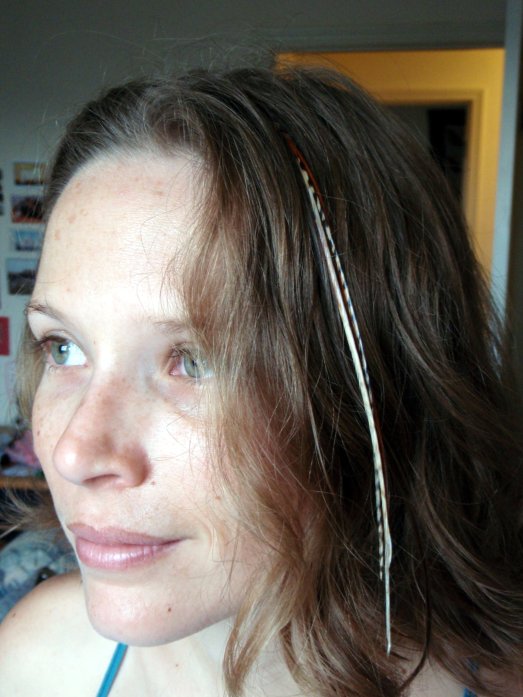
In December Tara and I flew to Oregon to visit family for the Holidays. My younger brother's girlfriend introduced us to the latest fashion: hair feathers.
"I could tie a nice fly with those" was my immediate thought, and in fact it turns out that fly shops are the main retailer for hair feathers. So when Tara got her own feathers, I made her promise to give them to me when she took them out so that I could tie some flies.

Tying flies is a classic, almost cliched winter time activity. Many fly fishers spend these cold, dark days at the vise stocking fly boxes with a careful assortment of patterns, sizes and colors. I do not. I like to go through my flies and throw a bunch out. At the end of the process, this is how I like my fly box to look:
Above is my back-up box, it holds 90% of my flies and usually sits unused for most of the year. The box I actually carry on my person when I fish looks like this:
Between the two boxes: 44 flies. Add in the odd salt-water patterns and over-sized poppers I have lying around and you have a grand total 59 flies. For most fly fishers, the discovery that they possess only 59 flies will send them into a feverish frenzy of fly-tying. I'm not kidding. I once read a fly-tying article in which the author pronounced that he never went fishing without at least three boxes of ant flies! Three boxes? Of ant flies? Seriously? It's enough to make me question my methods. I guess I'm either doing something very wrong, or very, very right.

Tuesday, January 18, 2011

NOVEMBER: stripers

NOTE: I am not a big fan of winter. When the weather turns cold I get less active; I do less fishing, and less blogging. Due to a fairly cold and snowy winter so far, I've gotten two months behind in posting what little fishing-related news I do have. In an effort to catch up, I intend to retroactively publish posts for November and December.

The carp had gone deep for the winter and so my friend Toby suggested we catch some bait and try for striped bass. Our first stop was below the dam where Toby managed to hook two baitfish (herring or shad of some kind.)
Next we headed above the dam and rigged up four rods with fresh cut-bait. We had some action on one rod but whatever was out there avoided the hook and escaped with a meal. It was a bit too cold to be comfortable just standing around but we stayed out until dusk, which, at this time of year, comes at around 4:30 pm!